

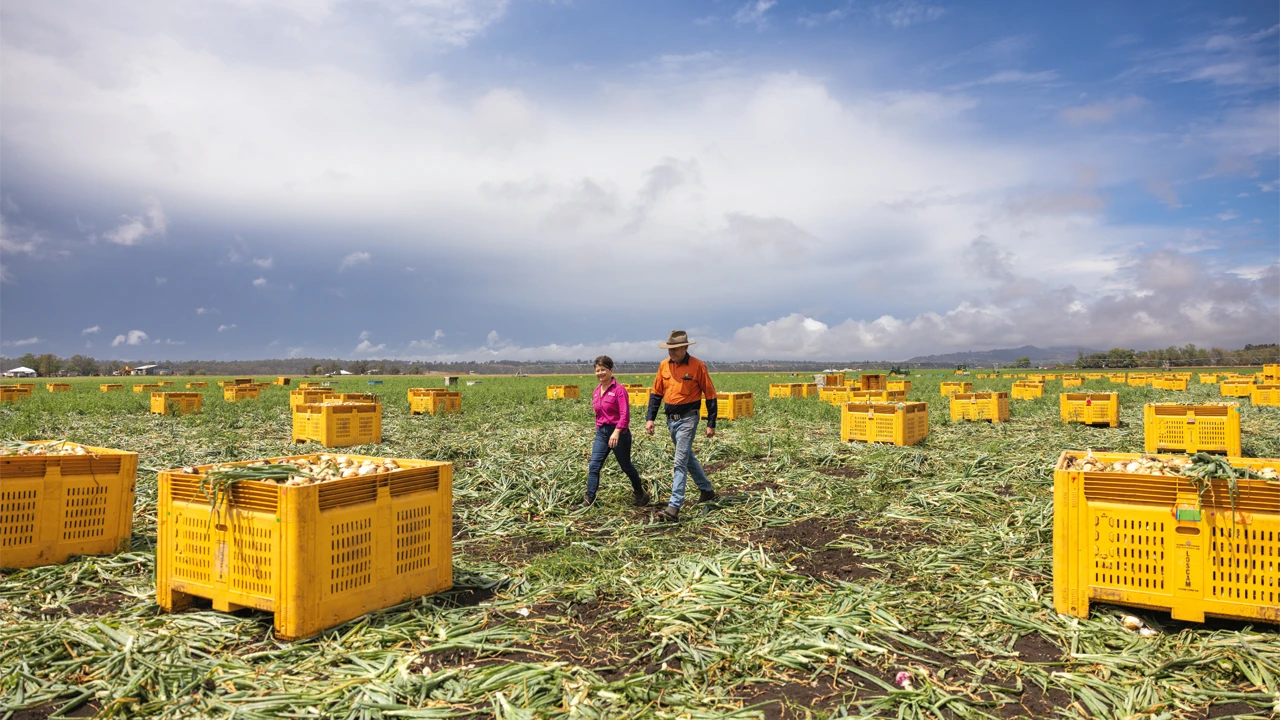
The reintroduction of cotton has added further diversification to the Brimblecombe family’s Lockyer Valley farming operation.
Story Bruce McMahon Photos David Kelly
The Brimblecombe family of Moira Farming, just outside the village of Forest Hill in Queensland’s Lockyer Valley, are an industrious mob, producing an array of crops from broccoli to wheat, and carrots to cotton.
There has long been a mix of produce from this property. Its history stretches more than 100 years to when George Brimblecombe returned from World War I. Wounded on the battlefields of France, George recuperated in an English town called Moira before heading home to spend his war income on a farm. “He didn’t waste his money over there – didn’t drink or smoke – so he was able to buy his first block of dirt and he called it Moira,” says his great-grandson Mitch Brimblecombe.
On that first 32ha, the returned soldier grew hay, grain, corn and onions. That was typical Lockyer farm produce back in the 1920s. Today, Moira Farming stretches over more than 800ha, including some share paddocks, on black alluvial plains alongside the Lockyer Valley’s Sandy Creek. Some weeks the Brimblecombes – Mitch and his wife Mariah, Mitch’s mother Melinda and his father Linton, plus nine staff – harvest one paddock and plant the one alongside. It’s a diverse, very successful operation, as proven by Moira Farming being awarded Bayer Cotton Grower of the Year in 2026.
“We’re planting something every week. It goes round and round,” Linton says. “It was sweet corn and green beans last week. Onions we’re harvesting today. We grow a vegetable range that suits our soil and climate – everything for your roast dinner, except the potatoes.” Linton favours carrots: “You can pull them up and eat them”. Melinda likes beetroot: “You can slice them, dice them, boil them, grate them”.
Cotton now takes up some 550ha of the farm and that diversification is vital for the farm’s future. “Six years ago all our dams were empty. We couldn’t grow vegetables here, although we have another farm at Kalbar [in nearby Fassifern Valley] where we could,” Mitch says. “This entire farm here was sitting dormant. Our bore water’s too salty to grow vegetables.
“Anyways, we looked to our history and 30 years ago we used to grow cotton here. We remembered we can use that salty bore water as long as we flood or trickle irrigate and don’t let the water touch the leaf. The cotton is somewhat tolerant to the bore water.”
When they brought back cotton, the Brimblecombes first planted 40ha and when that went well, expanded to 160ha the next season, then 320ha, 480ha and now have ended up with almost 600ha under cotton.
The 5,600ha Bonnie Doone, bought in 2002, is the home block and centre of the Burnhams’ world. Visitors are greeted by timeworn blue gums – knowledge-keeping trees sucking water from the nearby Cattle Creek. The water is filtered by the coarse sand and, alongside the tree roots, a bore extracts water for Bonnie Doone.
Marking the entry to the homestead is a timber post and rail fence, adorned with a simple sign: “We’re making good ground”.
This story excerpt is from issue #170
Outback Magazine: Dec/Jan 2027


