

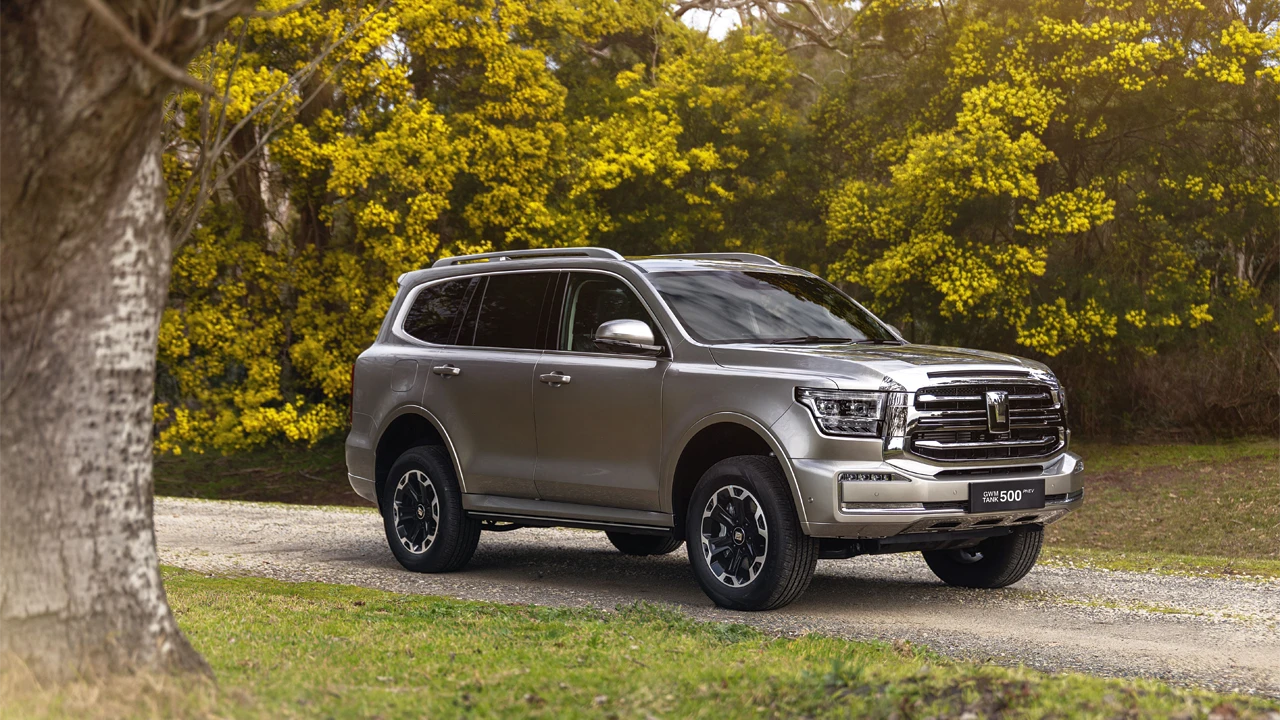
GWM’s Tank 500 swells the ranks of family tourers.
Story Bruce McMahon Photo GWM
Some SUVs may rarely leave the tar these days, but family-focussed 4WD wagons have long been a mainstay of Australian showrooms. Today, the new-age Ford Everests, Toyota Prados and a revived Pajero face an ever-growing line-up from Chinese makers. Among these, GWM or Great Wall Motors, has become an established player, with recent SUV offerings benefiting from Australian tuning of both chassis and driver-assistance systems. The results of tweaking wagons for local tastes are heralded by GWM’s Tank 500 Hi4-T PHEV, a plug-in hybrid 4WD with family adventure appeal.
This particular Tank 500 runs a 2L petrol engine with 120kW electric motor, good for a combined 300kW and 750Nm of torque, allied with a nine-speed transmission and two-speed transfer case for 2WD, all-wheel drive, 4H and 4L.
The upside to this Tank is the ability to plug-in and top up the 37kWh battery for around 100km of electric range. The downside is that a bigger battery means the PHEV version is only a five-seater, as opposed to seven-seater hybrid and diesel versions.
All arrive in a clean-cut body, straight and solid lines that could see the Tank 500 mistaken for one of Toyota’s LandCruiser family. (Five metres long and 2m wide, it’s more of a Prado rival, undercutting the Japanese wagon on price and equipment.)
Perhaps the PHEV Tank could do with a touch less plastic chrome around the RAM-like nose, and perhaps beefier wheels and tyres would better set off the road stance, but the Tank will impress with its cabin space and wealth of features, from quilted, heated and cooled seats to automatic sidesteps that appear as the big doors are opened. The one-piece tailgate with spare wheel and tyre attached is a hefty swing, opening to a reasonable cargo area, while front and back seats offer excellent head, shoulder and leg room. Rear vision from inside is quite restricted, but aided here by a battery of cameras and sensors.
There are good storage spots and cubby holes, good ergonomics, with decent-sized shifter and chromed buttons on the centre console for off-road functions, including trail-assist turn for tight spots. Wood veneer pieces and an analogue-style clock are among premium finishing touches highlighting the Tank’s lounge-room appeal.
The infotainment touch screen is a large 14.6 inches, the driver’s instrument cluster a 12.3-inch screen with new-age details on power consumption and more. Nitpicking would include indicators that don’t cancel easily, leading to hitting them the opposite direction and back when changing lanes.
For the most part this is an easy, comfortable wagon out on the road. It sometimes feels a bit large around town, but settles into an easy lope down the highway or single-lane country road. Chassis and steering are perhaps not as fine-tuned and communicative as, say, a Ford Everest, yet it handles and rides rough rural roads with quiet confidence.
Weighing close to 3 tonnes, this isn’t a machine for throwing full pelt into mountain hairpins, but it is a well-mannered tourer. Even the warning bleeps and buzzers – for venturing over white lines or maybe yawning indiscreetly – are quite polite and muted compared to some.
With three locking differentials, reasonable ground clearance, 380Nm of torque from the petrol engine alone, plus cameras for off-roading and different drive modes for different surfaces, the Tank 500 is a fair off-roader, limited to some extent by highway tyres as standard gear. For many Australians it will go as far into the rough as needed or wanted.
For families, the big selling point could be the plug-in hybrid system. GWM suggests combined fuel consumption at 2.1L/100km and that’s close to achievable with stop-start city traffic, suburban and some limited highway running (where power is regenerated under slowing or braking). However, as the road stretches on and the battery is depleted, fuel consumption will head toward 10 or 11L/100km.
GWM’s PHEV Tank 500 is a worthy addition to the SUV ranks. It’s a value-packed five-seat wagon with family appeal, backed by a seven-year warranty, eight-year battery warranty and a network of 117 dealers. Drivers looking at regular long-distance work might consider the 3L diesel Tank 500, with claimed fuel consumption at 7.1L/100km and possible fuel range up to 1,800km, plus the diesel’s extra 500kg (3,500kg) in towing capacity.
This story excerpt is from issue #170
Outback Magazine: Dec/Jan 2027


