

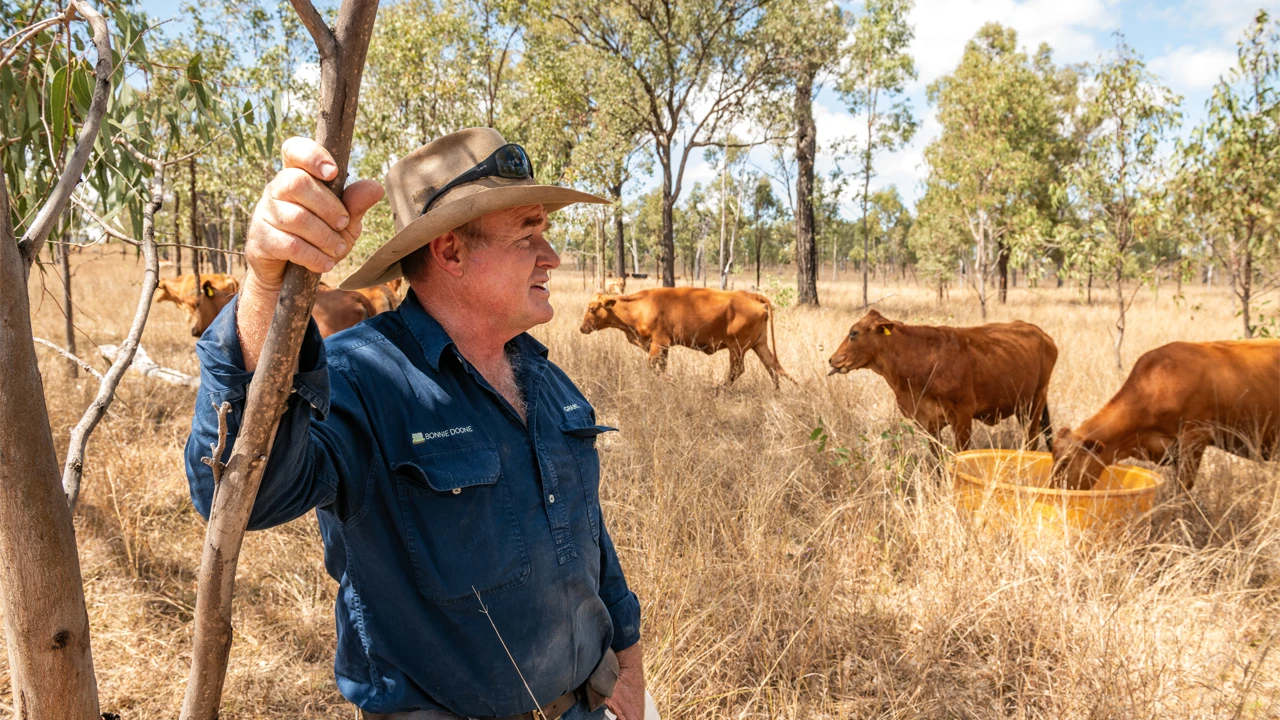
Soil underpins every decision made by the award-winning Burnham family on Bonnie Doone, in central Queensland.
Story + Photos Mandy McKeesick
A passing shower has fallen on Bonnie Doone, 45 minutes’ drive south-west of Monto in central Queensland and petrichor – the smell of rain on dry earth – engulfs the senses. Grant Burnham and his son Knox spear a pitchfork into the ground and extricate a mound of dark chocolate soil. It is knitted with plant roots and decaying vegetable matter, with white threads of mycorrhizal fungi reaching tentatively into the air. Knox bows his head and inhales. “If you could smell colour, this is what it would be,” he says.
The Burnham family – Grant, Carly and their children Lily, 25, Ruby, 23, Knox, 20, and Quade, 16 – run an organic cattle operation over 8,000ha, driven by a love for nature and underpinned by what lies beneath. “We consider ourselves soil stewards,” Carly says. “Our practices are focused on regeneration of the earth and improvement of our soils. We strongly believe healthy soils mean healthy animals, which means healthy humans and a healthy planet.”
The Burnhams come from generations of agricultural land managers. Carly’s roots stretch to 1838, when her forebears arrived in the Moreton Bay area and made their way north. Grant’s family arrived in the district in 1949 and set up camp on the Nogo River. His family bought a neighbouring block, the 2,400ha Barram, entwining the families in Monto’s history. Barram now forms part of their business, meaning one parcel of land has been in the immediate family for 99 years.
The 5,600ha Bonnie Doone, bought in 2002, is the home block and centre of the Burnhams’ world. Visitors are greeted by timeworn blue gums – knowledge-keeping trees sucking water from the nearby Cattle Creek. The water is filtered by the coarse sand and, alongside the tree roots, a bore extracts water for Bonnie Doone.
Marking the entry to the homestead is a timber post and rail fence, adorned with a simple sign: “We’re making good ground”.
This story excerpt is from issue #170
Outback Magazine: Dec/Jan 2027


